Your editors each keep their own system because the shared one doesn't answer their questions.
It's not laziness and it's not ego. Let's go over why it happens and what it actually costs.
Why do editors build private systems?
The shared folder is organized for the person who uploaded it: by creator, by date, by campaign. That's how footage arrives.
An editor's question is different: "where is the take where she says it absorbed fast, and is there a close-up of the dropper I can cut to?"
The folder can't answer that. So the editor watches everything once, writes down what they found, and keeps the notes somewhere private:
→ A Notion doc of timestamps → A folder called "GOOD STUFF" → Premiere bins that only exist on their machine → Their memory
It works for them. For about as long as they stay.
What does it actually cost?
I've seen this at every brand I did creative strategy for. The costs are the same each time:
| Cost | What it looks like | Who feels it |
|---|---|---|
| Scrubbing time | 3-4 hours on the first edit from a new creator drop, most of it watching, not cutting | every editor, every drop |
| Reused footage | the same 12 clips in every variation, the other 200 never opened | the founder paying for creators |
| The restart | an editor leaves, their system leaves, the next person re-watches everything | the whole team, for weeks |
| Strategist and editor out of sync | "use the skeptical moment" → "which one?" → three rounds of Slack | every brief |
The restart is the one that hurts most and gets noticed least, because it happens after someone is already gone. I've watched teams lose weeks to it.
What does a shared library need to answer?
The questions editors actually ask. Four of them:
→ What's said: the full transcript, timestamped, searchable by meaning and by exact words → What's shown: a description of every moment, searchable ("dropper close-up, clean background") → Who's on camera: faces indexed so "every clip with Maria" is one click → What kind of moment: hook, demo, testimonial, b-roll, plus the 10-15 actions that matter in your category
If the shared system answers all four, the private folder has no reason to exist. If it answers none, it's a Drive folder with a nicer name.
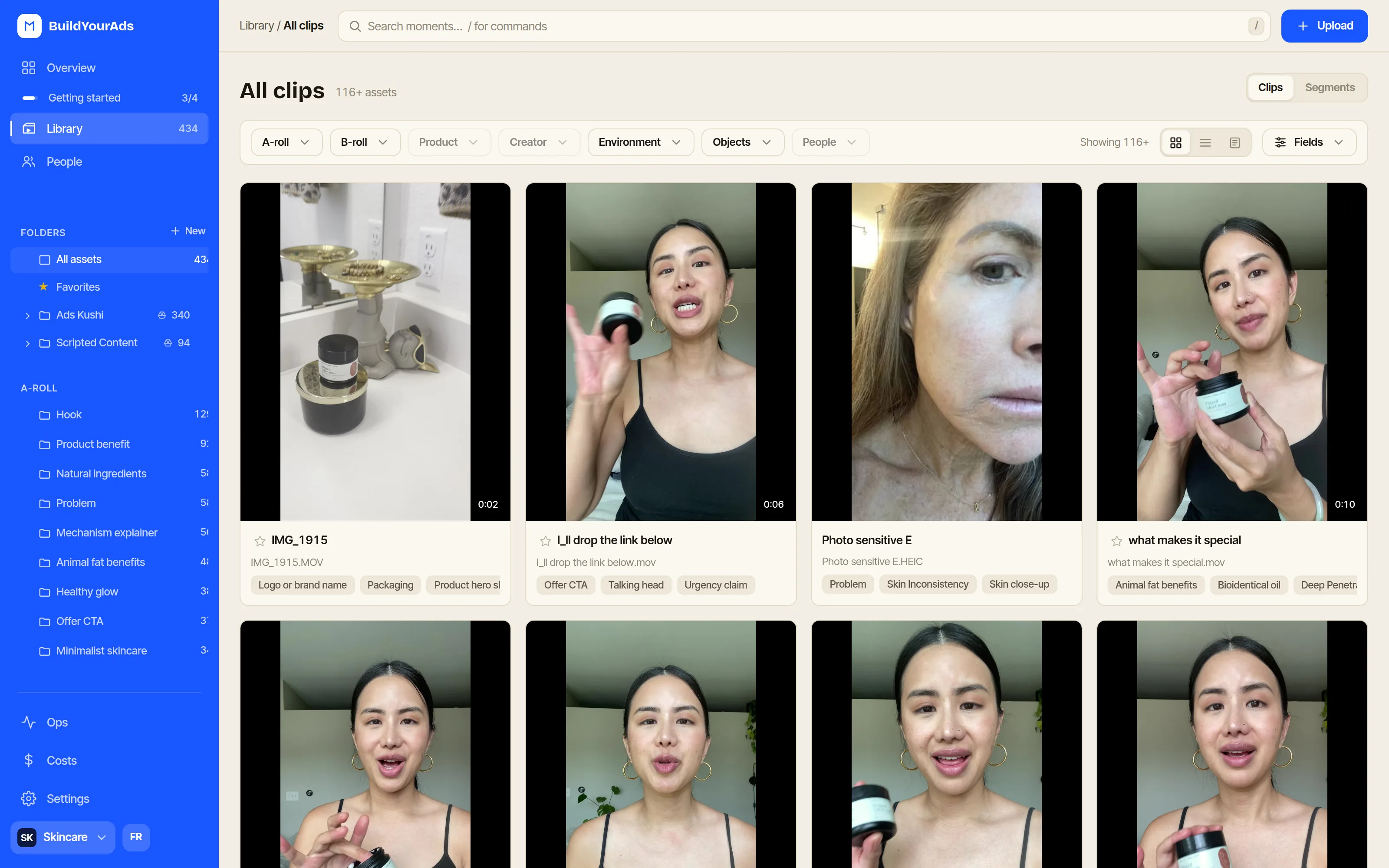
One library for everyone. Same tags, same search, for every editor.
How do I know if the shared system is good enough?
Idea: the test is simple. Can a new editor, on day one, find this without asking anyone:
the take where she says she was skeptical, outdoors
If yes, nobody needs a private folder. If no, they'll build one by Friday. Run that test with the newest person on the team, not the one who built the folders.
What changes when it works?
Let's say a creator drop lands on Monday night. Tuesday morning:
→ The strategist searches three moments and puts the links in the brief. 10 minutes. → The editor opens Premiere, pulls those segments into a bin from the panel, cuts. No scrubbing. → A second editor builds a variation from the same links. Same footage, no re-watching.
The private systems go away on their own. Not because you banned them. Because the shared one answers the question faster.
What stays with the editor?
The cut. The library finds the takes; it doesn't decide the pacing, the music, where the text goes, or which of the 14 takes has the better delivery. That's the job, and a good library gives editors more time for it, not less.
Taste in takes also stays human. Two takes of the same line, one is better. The library shows both with timestamps. The editor picks.
Your first two weeks
Week one: get all of last quarter's footage into one shared, searchable place. Don't ask editors to migrate their notes. Ask each of them for the three searches they run most often, and check those work.
Week two: one brief with links instead of descriptions, one editor on the Premiere panel. Then ask the newest editor to find "skeptical, outdoors" cold. If they can, you're done. If they can't, the label or the transcript is missing, and that's a one-hour fix.
FAQ
How do I get editors to use a shared library?
Make it faster than their own system for the question they actually ask. If the shared library finds "the take where she says X" in seconds and their folder takes ten minutes, they switch without being asked. Mandates don't work; speed does.
What should a shared footage library contain?
Every clip, transcribed with timestamps, cut into segments, tagged by type (hook, demo, testimonial, b-roll) and by category-specific actions, with the people on camera indexed. Plus a way to pull a segment straight into the editing software.
How much time does a shared library save per ad?
Let's say finding the takes costs 3-4 hours per ad today. Once footage is searchable by what's said and shown, that part becomes a few searches. The cutting time doesn't change. The searching time is what disappears.
Should editors still keep their own Premiere bins?
Of course. Bins are how an edit is organized. The difference is that the bin gets filled from a search, not from a private folder system that only one person understands.
What happens to the notes editors already made?
Keep them, don't migrate them. Once the library is searchable the notes stop being needed. Migrating them by hand is the kind of project that never finishes.
Does this work for freelance editors who come and go?
It's the case it helps most. A freelancer gets a seat or an API key, searches the same library as everyone else, and nothing leaves with them when the project ends.